- QA test automation
- Automated testing and monitoring
- Video service monitoring
What is video testing and monitoring?
By Noemie Galabru, CMO
Picture this. It is Friday night, the new Pluribus episode is out, and you press Play. Instead of starting instantly, the screen buffers and the image struggles to load. What should have been a relaxing start to the weekend instantly becomes a frustrating experience.
When a viewer presses “Play,” they expect one thing: for the video to start instantly and look great. If it buffers, freezes, or plays at poor resolution, the experience is ruined, no matter how good the content is.
This is exactly what video testing and video monitoring are designed to prevent. They help engineering, QA, and operations teams understand how their service behaves on real devices so that viewers never face these moments. In streaming, quality of experience (QoE) defines whether viewers stay engaged or churn.

Understanding video testing and video monitoring
Video streaming may look simple to viewers, but behind each play request is a complex chain of encoders, CDNs, players, networks, and devices. Video testing and monitoring help teams validate and observe this chain end-to-end.
What is video testing?
Video testing is the QA process used to verify that a video service works correctly before it reaches viewers. It includes:
- functional testing of navigation and playback
- video quality testing for resolution, bitrate, and fluidity
- device testing across smart TVs, mobile apps, browsers, and set-top boxes
- automated testing powered by scripts or AI
QA teams run these tests to identify issues such as buffering, resolution drops, audio sync issues, or failed playback. It is proactive, structured, and conducted in controlled environments.
What is video monitoring?
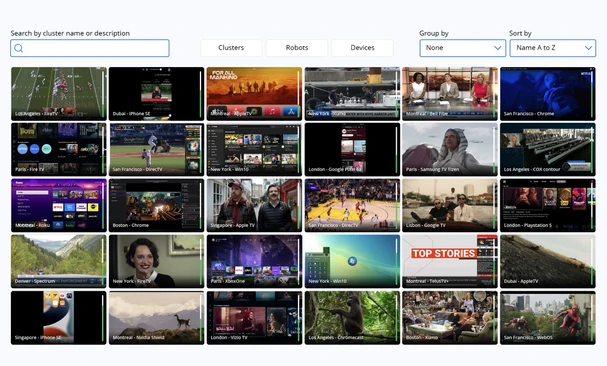
Video monitoring continuously observes the actual performance of a video service in production. Instead of running a fixed test, monitoring captures what viewers truly experience in real time.
Common monitored KPIs include:
- video start time
- rebuffering ratio
- bitrate and resolution changes
- video errors and crash rates
- ad insertion performance for AVOD and FAST channels
- UI responsiveness on the device
This type of monitoring is often operated via a Virtual NOC and is essential to detect and solve real-world issues before they affect many viewers.
Why both testing and monitoring are needed
Testing and monitoring address different but complementary stages of a streaming service lifecycle.
- Video testing ensures the service works before launch
- Video monitoring ensures the service continues to work after launch
Together, they form a complete QA testing workflow that starts in the lab and continues in the field. As release cycles speed up, these two stages increasingly overlap, and many teams now rely on continuous QA testing directly in the field to ship updates faster and with greater confidence.
You can read more about this shift to continuous QA in the field here.
Key metrics behind video testing and monitoring
To understand video performance, teams measure two main concepts: QoE and QoS.
Quality of experience (QoE)
What the viewer actually sees on their screen. Examples
- playback success
- visual clarity
- smooth motion
- loudness stability
- responsiveness of the interface
Quality of service (QoS)
What the delivery chain reports
- network throughput
- CDN availability
- error codes
- server-side timings
QoE shows what the user experiences.
QoS shows how the system behaves.
Modern streaming teams must measure both, ideally with technologies that are interconnected like TAGvs and Witbe.
The importance of real-device testing
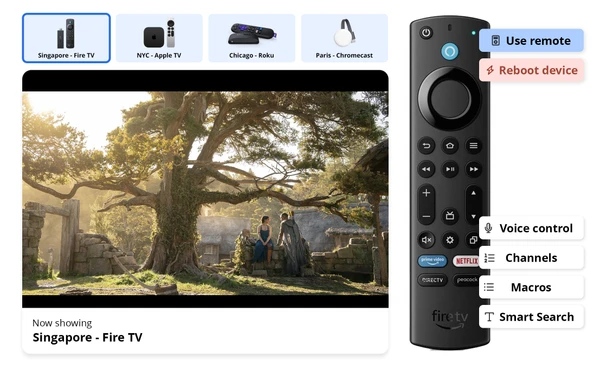
Streaming services run on hundreds of device models and OS versions. This is called device fragmentation, and it is one of the biggest challenges in video testing. A flawless experience on one smart TV does not guarantee the same on another.
This is why leading QA teams rely on real-device testing, not emulators or synthetic players.
Only real devices reveal:
- OS fragmentation issues
- firmware-specific bugs
- layout changes introduced by manufacturers
- real player logic
- true video rendering quality
Real-device testing is the foundation for reliable QA and accurate monitoring.
Where automation fits in
Modern QA teams rely on test automation to scale their work efficiently. Automation can:
- launch apps automatically
- navigate through menus
- play videos and measure QoE KPIs
- run regression tests for every app update
- perform OTT performance testing on multiple devices at once
- trigger alerts when monitoring detects issues
With new advances in AI-powered test automation, identical workflows can now be executed consistently across devices.

Why video testing and monitoring matter more than ever
As streaming grows in complexity with more devices, formats, and ad layers, the margin for error becomes smaller. Common issues like buffering, failed starts, and ad insertion problems directly impact viewer satisfaction and revenue.
Effective video testing and monitoring deliver:
- higher viewer retention – reducing churn through better QoE
- faster issue detection
- fewer support tickets thanks to proactive detection
- faster release cycles for new player versions or app updates
- operational confidence during major events
Service quality has become one of the most important differentiators in a competitive market.
Looking ahead
Video quality expectations are rising. As AI, automation, and real-device observability advance, testing and monitoring will become even more integrated into every stage of the streaming workflow. Providers that invest early in robust QA and live monitoring will be equipped to deliver consistently excellent experiences across all platforms.
Conclusion: delivering quality in every frame
Every great streaming experience begins with reliable video testing and continuous real-world monitoring. Together, they allow teams to understand exactly what their viewers see and ensure that every frame meets the highest standard of quality on every screen including mobile devices.

This video requires additional cookies
This YouTube video uses third-party cookies. To watch it, please update your cookie preferences.