Book a demo
See exactly how we test and monitor video services on real devices
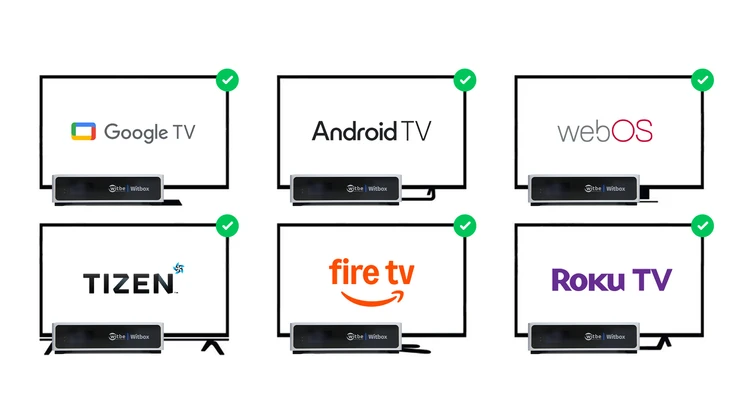

Emulators can’t replicate how Smart TVs process video, handle firmware, or render UI. Witbe tests on actual Samsung, LG, Sony, Philips, and other Smart TVs: the same devices found in your customers’ homes.
Smart TV Automation detects:
Whether you’re a streaming app provider validating across multiple TV brands or a manufacturer ensuring platform stability, Witbe delivers pixel-perfect, reproducible validation on real hardware.

Once connected to the Witbe platform via the Witbox, every Smart TV can be remotely accessed, tested, and analyzed by teams anywhere in the world.
This removes the need to ship TVs to engineers or maintain on-site test labs.
Operational benefits:
The result is scalable global visibility, consistent testing standards, and faster collaboration between distributed teams.

Write once, test everywhere. Witbe’s technology can run the same scenarios across Samsung, LG, Sony, and all major platforms.
With Witbe’s smart TV automation:
This guarantees full consistency and repeatability across every smart TV environment, from development to live production.

Each test captures real-time video, screenshots, and audio directly from the TV. Smartgate consolidates everything: from KPIs to visual logs for immediate triage and long-term analytics.
Calibration ensures accurate color and centering, while fuzzy image recognition compensates for ambient lighting and reflections.
Audio validation confirms proper signal output and detects playback or channel issues.
All metrics, recordings, and QoE KPIs are automatically aggregated in Smartgate, where teams can:
The results is a single, reliable source of truth for visual quality, playback accuracy, and long-term performance tracking.

Witbe’s Smart TV screener is built for lab efficiency: compact, easy to mount, and ready to go out of the box.
Hardware highlights:
Deploy a complete testing setup in hours. Built for flexibility and precision, the system provides a stable environment for continuous Smart TV monitoring in any lab or datacenter or even a regular office space.
Scalable as your catalog and device portfolio grow.
Validate exactly what viewers see on physical Smart TVs, not emulators or screenshots.
Access and automate tests on Smart TVs anywhere in the world, across every brand, OS, and app; native or third-party.
Deploy complete Smart TV test setups quickly, with an adaptable frame, multi-size compatibility, and light protection for consistent visual accuracy.
It is Witbe’s automated testing solution for validating video apps on Smart TVs. It ensures consistent playback, navigation, and visual accuracy through automation on real devices.
Witbe supports all major brands and operating systems, including Android TV, Tizen, webOS, Samsung, LG, Sony, Panasonic, Hisense, Vizio, and others. If it supports IR control and streams video, it’s supported.
The smart TV automation setup is compatible with screens ranging from 43 inches to 65 inches, and can be stacked for multi-screen environments or dense lab installations.
Yes. Witbe validates third-party OTT apps just like native ones, confirming that each app launches, navigates, and plays content correctly across different TV brands.
Yes. Witbe supports full validation of encrypted and high-resolution streams through the actual device and app environment.
No. Smart TVs can be hosted in your facility or at a Witbe datacenter and controlled remotely through the Witbe platform.
All results appear in Smartgate, where teams can view KPIs, dashboards, and video recordings for detailed analysis and reporting.
The Witbe smart TV automation stack is designed for dense, modular setup: multiple TVs can be stacked vertically or mounted on a wall. Each setup includes one TV, a Witbox, and the necessary cables and cover, all compact enough to fit into standard lab or office environments.
Pre-configured units are operational within hours: connect, calibrate, and start testing the same day.
See exactly how we test and monitor video services on real devices