- Industry News
- Video mobile automation
- Video service monitoring
Test automation for short-form video apps
By Christophe Vié, Enterprise Account Executive, US West Coast5 min read
Short-form and vertical video apps iterate their interfaces faster than long-form streaming services, often weekly. Traditional test automation is built on rigid scripts, so it breaks every time a button moves and coverage quietly erodes into maintenance. AI-powered hybrid automation is a different model: deterministic logic for the steps that must be exact, agentic AI for the steps that shift with the UI, so tests keep collecting data through change instead of failing on it.
There's a quieter problem hiding behind the rush to ship vertical feeds. The feeds are new, and new features move. Layouts get rearranged, navigation gets renamed, a swipe target shifts a few pixels.
For the QA team, every one of those changes is a chance for the test suite to break. Whether it actually does depends on which automation model that suite is built on.
Why does traditional test automation break on short-form apps?
Traditional automation is scripted automation. A test is a fixed sequence: find this element, in this place, in this order. It depends on the interface staying exactly where it was when the script was written.
That's a reasonable assumption for a stable app. It's a losing one for a short-form feed that ships UI updates on a weekly cadence.
When the UI moves, the script fails, not because the feature is broken, but because the test can no longer find its way through it. The team spends its time repairing tests instead of catching real problems. Coverage degrades into theatre: the suite runs, but it's mostly checking whether last week's layout still exists.
What does traditional automation cost when the UI moves?
Two things, both expensive.
First, maintenance time, engineers rewriting scenarios that the app's own release cadence keeps invalidating. And every fix is per-scenario: the same navigation change has to be corrected in every test that touches it.
Second, and worse, lost coverage during the gap: while a test is broken and waiting to be fixed, the failures it was meant to catch go undetected. On a feature shipping weekly, that gap is never closed for long.
How is AI-powered hybrid automation different?
Not more scripting. A different structure.
Traditional automation asks one script to be right about the whole interface. AI-powered hybrid automation splits the problem in two.
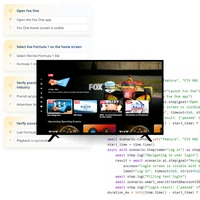
Deterministic logic handles the parts of a test that must be exact and repeatable: the validation, the timing, the KPI measurement. Agentic AI handles the parts that shift: a target that moved, a dialog that wasn't there last week, a path a rigid script would have abandoned.
The difference in behaviour is the point. A traditional script meets an interface it doesn't recognise and stops. A hybrid test keeps going, still measuring the same KPIs on real devices. When an algorithmic step can't find its target, AI-assisted fallback continues the run rather than dropping it, so data collection survives the change.
Fixes also propagate differently. With App Object grouping, you correct a navigation step once and every scenario that uses it inherits the fix instantly, with no per-scenario code edits. One repair, not fifty.
This is the design behind Witbe's Agentic SDK in Test Studio. Production numbers from a large short-form deployment show what the difference looks like against the scripted framework it replaced:
- 5 captures instead of 22 for the same scenario: a reduction of more than 75% in the surface that needs maintaining.
- A UI change resolved in under five minutes with a capture update, instead of hours of code rework.
- A new scenario from development to production in three weeks. In the fastest case, a scenario was scripted in a day, validated over the next two, and collecting data across the weekend.
- A sharing scenario estimated at six months under the legacy scripted framework reached client validation in four weeks.
- Zero datapoints lost during maintenance, because AI-assisted fallback keeps collecting when an algorithmic step breaks.
The broader benchmark, presented by Witbe COO Yoann Hinard at the 2026 BEIT Conference: roughly 80% less test maintenance on Smart TVs in black-box conditions across UI changes.

Why the gap between the two models is widest in short-form
Long-form streaming UIs are relatively settled, so traditional scripted automation survives longer there. Short-form feeds are not settled. They're the most actively iterated surface in the app, precisely because services are still tuning them for engagement.
The faster the UI changes, the faster traditional automation decays, and the more an AI-powered hybrid approach pays back. Short-form is where scripted automation fails first, and where hybrid automation earns its place quickest.
Where this fits
Keeping tests alive is what makes continuous short-form measurement possible in the first place. For the metrics those tests protect, see the KPIs that define short-form QoE; for the full primer, start with monitoring short-form and vertical video across devices; and for the technology itself, see the Agentic SDK page.
Frequently asked questions
Why does traditional test automation break on short-form video apps?
Because traditional automation is scripted: it assumes a fixed interface. Short-form feeds change their UI frequently, often weekly. Each layout or navigation change can stop a script from finding its path through the app, breaking the test even when the feature works.
What is the difference between traditional and AI-powered hybrid test automation?
Traditional automation runs a fixed script and fails when the interface moves. AI-powered hybrid automation combines deterministic logic for the steps that must be exact with agentic AI that adapts to interface changes, so the run continues and validation stays anchored to measurable KPIs on real devices.
How do you reduce test maintenance on a changing UI?
By reducing the rigid, hand-scripted surface and letting an agentic layer absorb UI change. In one production short-form deployment, this cut the same scenario from 22 captures to 5 and resolved UI changes in under five minutes.
Does AI-powered hybrid automation lose data when a step fails?
With AI-assisted fallback, no, when an algorithmic step can't complete, the system continues the run and keeps collecting data, rather than dropping the datapoint.